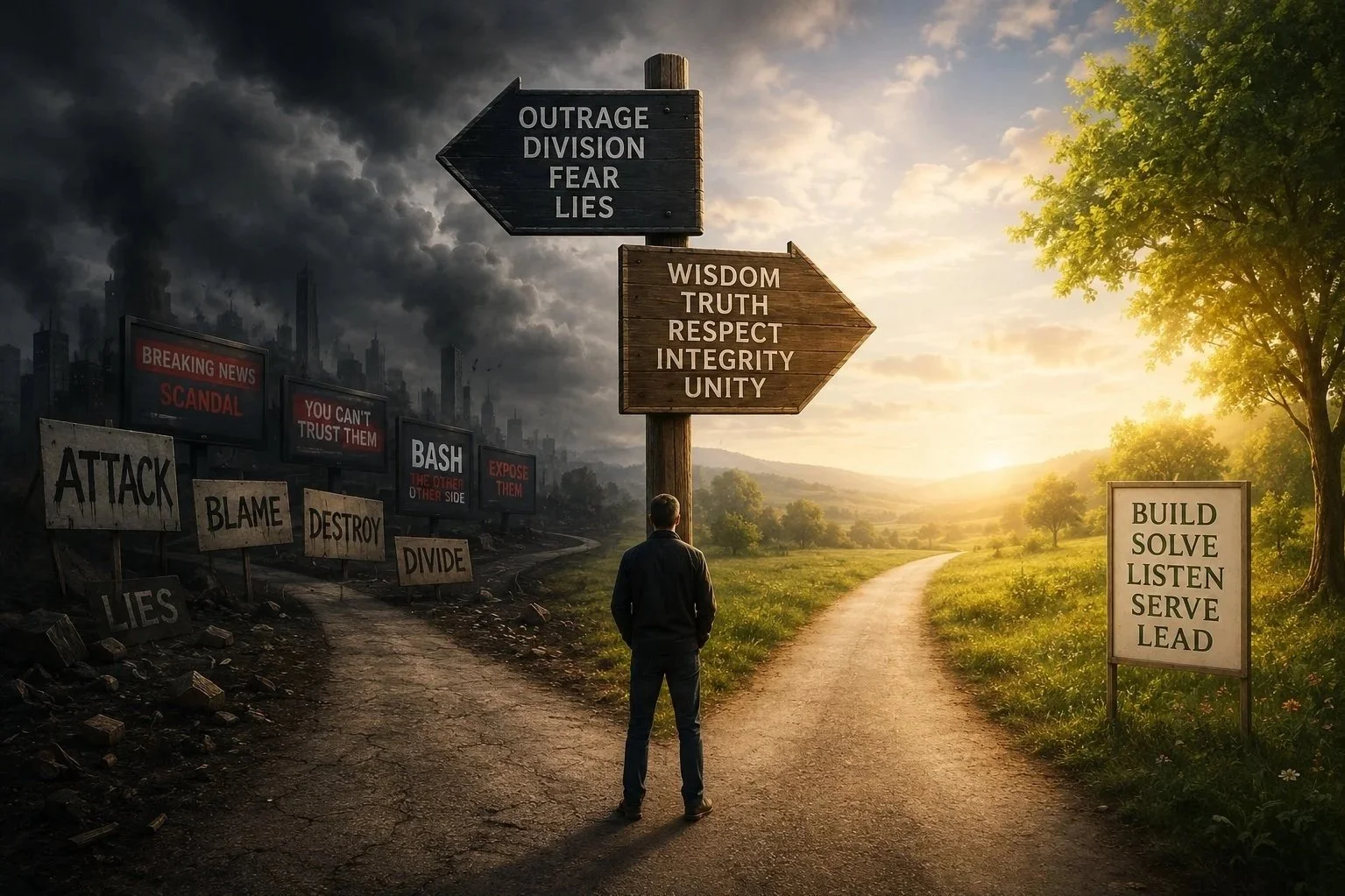
Too often we have traded wisdom for winning
I woke up recently in what I can only describe as a bad mood.
The strange thing is, I couldn't find a reason for it.
The weather was beautiful. The rain had finally come. My family is healthy. My work is meaningful. My life is full of blessings for which I am deeply grateful.
Yet something felt heavy.
As I thought about it throughout the morning, I realized that for weeks my eyes and ears have been saturated with negativity. Turn on the television and it is there. Open social media and it is there. E-mails and mailboxes are full of it. Text messages that I didn’t even ask for buzz my phone with political attack ads of candidates, elected officials, and anyone with a keyboard or enough money to create such garbage throwing mud at one another in an endless cycle of accusations, character attacks, half-truths, and division.
Somewhere along the way, we accepted the idea that this is simply how politics works. We tell ourselves that if someone seeks public office, they should be tough enough to withstand the mud. We shrug our shoulders and say, "That's politics."
But does it really have to be this way?
I opened my Bible this morning and found myself in Proverbs 2. As I read verses 9-15 and later verses 20-22, I was reminded that wisdom has always stood in contrast to corruption, perversity, and deceit.
The writer, King Solomon, describes people who "delight in doing wrong," who "rejoice in the perverseness of evil," and whose paths have become crooked. Reading these words, I couldn't help but think about the public discourse surrounding us today.
Why does nastiness seem to be rewarded? Why do character assassinations generate more attention than thoughtful solutions? Why do lies travel faster than truth? Why have temper tantrums become acceptable behavior among adults seeking positions of leadership?
The answer, I suspect, is not because our society lacks intelligence. It is because wisdom and intelligence are not the same thing.
Wisdom requires self-control and integrity. Wisdom requires us to speak truthfully about those with whom we disagree. Wisdom requires us to remember that every person—whether we support them or oppose them—is made in the image of God.
Too often we have traded wisdom for winning. And when winning becomes the ultimate goal, character becomes optional.
The unfortunate consequence is that this constant negativity does more than damage candidates. It damages communities. It creates cynicism. It teaches our children that leadership is about tearing others down rather than building something worthwhile.
As a school board member, I often think about the example we are setting for the next generation. We tell students to be respectful and kind. We teach them about what it means to be an upstanding citizen. We encourage them to disagree without being disagreeable. Yet, then many of them go home and watch adults do exactly the opposite. No wonder we have anti-bullying programs in our schools- yet society blames public schools for all of what’s wrong with educating our children today.
No wonder I woke up in a bad mood that morning and I wonder if you ever feel the same?
I am exhausted and tired of our culture where mud-slinging has become entertainment and division has become normal business for the sake of “winning an election” — even on a local level.
I am not naïve enough to believe disagreements will disappear. Nor should they. Healthy debate is essential to a free society.
But there is a profound difference between debating ideas and destroying people in order to win - or on the other hand, fear of loosing power.
One shows strength in a democracy. The other shows weakness.
Proverbs reminds us that wisdom leads us to "walk in the way of good people and keep to the paths of the righteous."
Perhaps that is a challenge before us today: not to simply choose leaders despite the garbage that is created about them or by them, but to select people who value wisdom over outrage, character over theatrics, and truth over tribalism.
There is an old adage that my Mom has often reminded me of and it goes something like this: “Great minds talk about ideas; average minds talk about things; small minds talk about people.'‘ Perhaps one measure of leadership is what occupies our conversations. Small leaders talk about their opponents. Great leaders talk about ideas, solutions, and a vision for the future. When an elected official’s camp spends more time talking about people than principles, more time discussing opponents than ideas, and more time attacking character than offering solutions, perhaps we should question whether it is leadership we are witnessing at all.
And perhaps this is also a challenge for those who lead or seek to lead “we the people.”
If you want to earn the trust of the people, tell us who you are. Tell us what you believe. Tell us what you have accomplished. Tell us what you hope to achieve. Share the convictions, character, and vision that make you worthy of the office you seek.
Show us your ideas. Show us your solutions. Show us your leadership.
Stop assuming that the path to victory requires finding or worse yet, creating every ounce of mud to sling at your opponent because you fear losing power, influence, control, or the title you call leadership.
Too often, these attacks reveal more about the person throwing them than the person they are aimed at.
Leadership is not measured by how effectively you tear someone else down. It is measured by how faithfully you build something better. And if your greatest message is the flaws of another person, perhaps the real question is whether you have given us enough reasons to believe in you.
Power is temporary. Titles are temporary. Elections come and go.
But character endures.
So to every candidate, every elected official, every political consultant, and every organization seeking to influence the public: give us something higher. Give us something worthy of supporting rather than simply someone to oppose.
Show us the truth within yourselves that is worth sharing.
Lead with conviction instead of fear. Lead with principle instead of outrage. Lead with courage instead of contempt.
If we truly desire better government, stronger communities, and a healthier nation, it must begin with leaders who understand that winning an election and demonstrating leadership are not always the same thing.
Perhaps if we spent less time destroying one another on a keyboard, the use of half-truthed AI ads, or video snippets taken out of context and more time elevating what is good, true, and honorable, we would discover that the kind of leadership we long for has been within our reach all along.